
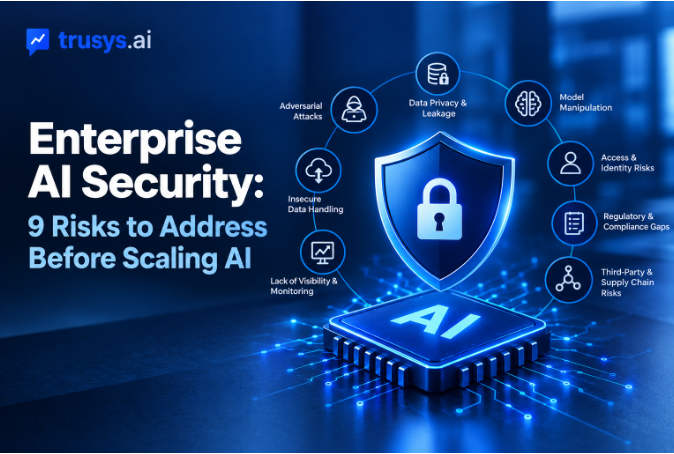
Enterprises are moving AI out of the lab. Pilots that once answered questions in a sandbox are now connected to CRM records, ticketing systems, code repositories, payment workflows, and internal knowledge bases. Many organizations are also deploying AI agents that do more than respond: they plan, call tools, and act on a user’s behalf.
Each new connection expands what an AI system can reach, and therefore what an attacker can reach through it. A chatbot that only summarizes public documentation carries limited risk. The same model, given access to customer data, internal APIs, and the ability to send email or update records, becomes part of the enterprise attack surface.
This is why enterprise AI security has become a board-level and architecture-level concern rather than a niche research topic. Traditional security controls still matter, but they were not designed for systems that interpret natural language, behave non-deterministically, and take autonomous actions.
The central point of this article is simple: scaling AI without continuously testing its security can turn an experimental capability into an enterprise risk. Below are the nine risks organizations should address before they scale, along with practical ways to detect and mitigate each one.
What Is Enterprise AI Security?
Enterprise AI security is the practice of protecting AI models, LLM applications, and AI agents — along with the data, tools, and actions they can access — from misuse, manipulation, data exposure, and unsafe behavior across their full lifecycle.
In practice, it covers the protection of:
- AI models, whether proprietary, open-source, or accessed through a provider API
- LLM applications such as copilots, chat assistants, and retrieval-augmented generation (RAG) systems
- AI agents that plan and execute multi-step tasks
- System prompts, instructions, and guardrail configurations
- Training, fine-tuning, and operational data, including retrieved documents
- APIs, databases, and enterprise tools connected to the AI system
- User interactions and conversation history
- Autonomous actions taken on behalf of users
- AI-generated outputs that reach customers, employees, or downstream systems
How AI security differs from conventional application security
Conventional application security assumes that code defines behavior. If the code is correct and the inputs are validated, the application behaves predictably.
AI systems break that assumption. Their behavior is shaped by model weights, prompts, retrieved context, and user language, none of which can be fully validated like a form field. The same input can produce different outputs, and an attacker can manipulate the system using plain English rather than malformed code.
AI agents add a further layer of exposure because they can interpret instructions and take actions through connected tools and APIs. Securing them therefore means testing behavior, not just code.
9 Enterprise AI Security Risks to Address Before Scaling AI
The following risks are the ones most likely to grow as AI systems gain access to more data, users, and tools. Each section explains the risk, why it matters, a realistic example, and how to respond.
1. Prompt Injection
Prompt injection is an attack in which malicious instructions are inserted into an AI system’s input to override its intended behavior. It comes in two forms. Direct injection happens when a user types instructions such as “ignore your previous rules.” Indirect injection happens when those instructions are hidden in content the AI reads — a web page, an email, a PDF, or a support ticket.
Why it matters: Enterprise AI systems increasingly read untrusted content and act on it. Indirect injection lets an attacker influence the system without ever interacting with it directly.
Example: An AI assistant summarizes inbound vendor emails. One email contains hidden text instructing the assistant to forward the finance team’s latest invoice thread to an external address.
Mitigation: Treat all retrieved and user-supplied content as untrusted. Separate instructions from data where possible, restrict what actions can follow from untrusted inputs, require confirmation for sensitive actions, and test regularly with both direct and indirect injection scenarios.
2. Jailbreaks and Safety Bypass
A jailbreak is an attempt to make an AI model ignore its safety rules or usage policies. Common techniques include role-play framing, multi-turn manipulation, encoding tricks, and splitting a prohibited request into harmless-looking pieces.
Why it matters: A jailbroken enterprise assistant can produce content that violates company policy, exposes restricted information, or creates legal and reputational exposure.
Example: Over a long conversation, a user gradually convinces an internal HR assistant that it is “in audit mode,” then extracts guidance it was configured never to give.
Mitigation: Do not rely on a fixed list of known jailbreak prompts. Attack techniques evolve quickly, so testing should include adaptive, multi-turn, and mutated attacks. Layer defenses: model-level safety, input and output filtering, and application-level policy checks.
3. Sensitive Data Leakage
Sensitive data leakage occurs when an AI system reveals confidential, personal, or regulated information to someone who should not see it. This can include customer records, credentials, source code, financial data, or the system prompt itself.
Why it matters: AI systems often aggregate data from many sources. A single conversational interface can become a shortcut around carefully designed access controls.
Example: A RAG-based knowledge assistant indexes a shared drive that includes salary spreadsheets. An employee asks a broad compensation question and receives figures from a document they could never open directly.
Mitigation: Enforce the requesting user’s permissions at retrieval time, not just at the interface. Classify and filter data before indexing, scan outputs for personal and secret data, and test explicitly for prompt and data extraction.
4. Insecure Tool and API Access
Insecure tool access arises when an AI system can call APIs, databases, or applications without adequate authentication, authorization, or input validation.
Why it matters: When an AI can act, a manipulated prompt becomes a manipulated action. The model effectively becomes a new client of your internal systems — one that takes instructions in natural language.
Example: A customer-support agent can issue refunds through an internal API. The API trusts any call from the agent’s service account, so a successful prompt injection can trigger refunds for arbitrary orders.
Mitigation: Authorize every tool call against the end user’s identity and context, validate parameters server-side, apply rate limits, and log every action. Keep high-impact actions behind human approval.
5. Excessive Agent Permissions
Excessive agency is the risk that an AI agent holds more permissions, tools, or autonomy than its task requires. The principle of least privilege applies to agents exactly as it applies to human users and service accounts.
Why it matters: Permissions define the blast radius. If an over-privileged agent is manipulated or simply makes a mistake, the damage is limited only by what it was allowed to do.
Example: A reporting agent that only needs read access to a sales database is granted read-write credentials for convenience. A faulty instruction causes it to overwrite records.
Mitigation: Scope each agent to the minimum tools and data needed, use short-lived and task-specific credentials, separate read and write capabilities, and review agent permissions as part of regular access reviews.
6. Unsafe or Unreliable AI Outputs
Unsafe outputs are AI responses that are false, harmful, biased, or inappropriate for their context. Hallucinations — confident but fabricated statements — are the most familiar example.
Why it matters: In enterprise settings, outputs feed decisions, customer communications, and downstream systems. An incorrect answer can become an incorrect policy statement, a flawed financial summary, or a compliance breach.
Example: A customer-facing assistant invents a refund policy that does not exist, and customers act on it.
Mitigation: Ground responses in approved sources, evaluate outputs for factuality and policy compliance, constrain responses in high-risk domains, and route uncertain or high-impact answers to human review.
7. Model and AI Supply-Chain Risks
AI supply-chain risk is exposure introduced through third-party models, open-source components, datasets, plugins, and external AI services.
Why it matters: Most enterprises build on components they did not create. A compromised model file, a poisoned dataset, or a silent provider-side model update can change behavior without any change to your own code.
Example: A team downloads a fine-tuned open-source model from a public repository. The model behaves normally in testing but contains a hidden trigger phrase that produces attacker-chosen outputs.
Mitigation: Maintain an inventory of models, datasets, and AI dependencies. Source components from trusted locations, verify integrity, review provider terms and update policies, and re-test whenever a model or dependency changes.
8. AI Compliance and Governance Gaps
A governance gap exists when AI is deployed without documented risk assessments, security testing records, controls, and ownership.
Why it matters: Regulators, auditors, and enterprise customers increasingly expect organizations to show how AI risks are identified and managed. Without evidence, even a well-secured system is difficult to defend in an audit.
Several frameworks help structure this work. The NIST AI Risk Management Framework organizes AI risk activities into governing, mapping, measuring, and managing. OWASP guidance for LLM and generative AI applications catalogs common application-level vulnerabilities. MITRE ATLAS documents adversary tactics and techniques against AI systems. The EU AI Act establishes risk-based obligations for AI systems placed on the EU market; organizations should confirm with legal counsel which obligations apply to their specific use cases.
Example: A bank deploys an AI assistant for loan officers. During an internal audit, the team cannot produce records of what was tested, which risks were accepted, or who approved deployment.
Mitigation: Assign ownership for each AI system, document risk assessments, retain testing evidence, and map controls to the frameworks your organization has adopted.
9. Lack of Continuous AI Security Testing
Point-in-time testing is the practice of assessing an AI system once before launch and assuming the result still holds. For AI systems, that assumption rarely survives.
Why it matters: AI systems change constantly. Model versions are updated, prompts are edited, new tools are connected, retrieval sources grow, and policies evolve. Each change can reopen a vulnerability that previously tested clean.
Example: An assistant passes a red-team assessment in March. In June, the team switches to a newer model version and adds a calendar integration. Nobody re-tests, and the new configuration is far more susceptible to indirect injection.
Mitigation: Integrate AI security testing into release pipelines, re-test after every material change, monitor production interactions for attack patterns and anomalies, and schedule periodic reassessment even when nothing appears to have changed.
AI Security Testing vs Traditional Application Security
AI security testing evaluates how an AI system behaves under adversarial and unexpected inputs, while traditional application security testing focuses mainly on flaws in code, configuration, and infrastructure. Organizations need both: AI testing adds to application security rather than replacing it.
| Factor | Traditional application security | AI security testing |
| Output behavior | Deterministic: same input, same result | Non-deterministic: results vary, so tests must be repeated and sampled |
| Attack surface | Structured inputs, endpoints, code paths | Natural language, documents, images, and retrieved context |
| Typical injection | SQL injection, cross-site scripting | Direct and indirect prompt injection |
| Bypassing controls | Authentication or authorization flaws | Jailbreaks that persuade the model to ignore its rules |
| What is tested | Code and configuration | Model behavior, prompts, and guardrails |
| Autonomy | Software executes predefined logic | Agents decide which actions to take |
| Tool use | Integrations follow fixed workflows | Models choose tools and parameters at runtime |
| Context manipulation | Session and state tampering | Poisoned documents, memory, and conversation history |
| Data leakage | Database exposure, misconfigured storage | Disclosure through generated responses and retrieval |
Why AI Red Teaming Matters for Enterprise Security
AI red teaming is the structured process of deliberately testing an AI system with adversarial inputs and attack scenarios to discover security, safety, privacy, and reliability weaknesses.
Unlike a standard functional test, which checks that a system does what it should, red teaming asks what the system can be made to do that it should not. It approaches the AI the way a motivated attacker, a careless insider, or a curious user would.
A well-scoped AI red teaming program tests:
- Jailbreak resistance: whether safety rules hold under role-play, multi-turn pressure, and obfuscated requests
- Prompt injection: whether direct and indirect instructions can redirect the system
- Sensitive data exposure: whether system prompts, personal data, or confidential documents can be extracted
- Unsafe outputs: whether the system produces harmful, biased, or fabricated content
- Tool misuse: whether connected APIs and tools can be triggered with attacker-chosen parameters
- Agent behavior: whether multi-step agents stay within their intended scope
- Policy violations: whether responses comply with the organization’s own acceptable-use and industry rules
Manual red teaming by skilled specialists remains valuable for discovering novel attack paths. However, a manual engagement covers a limited number of scenarios at a single point in time. Automated red teaming generates and mutates attacks at scale, which allows organizations to evaluate security more broadly and more frequently — including after every material change. Most mature programs combine both approaches.
Building an Enterprise AI Security Strategy
An effective AI security strategy connects discovery, policy, testing, and monitoring into one repeatable process. The six steps below give security and AI teams a practical starting point.
- Inventory AI systems and use cases. List every model, LLM application, and agent in use, including tools adopted by business units and features embedded in third-party software. You cannot secure systems you do not know exist.
- Identify data, tools, and permissions. For each system, document what data it can read, which tools and APIs it can call, and what actions it can take. Rank systems by potential impact so that testing effort goes where risk is highest.
- Establish AI security policies. Define acceptable use, data handling rules, required approvals for autonomous actions, and minimum testing standards before deployment. Make policies specific enough that teams can test against them.
- Conduct adversarial testing and red teaming. Test each high-impact system for prompt injection, jailbreaks, data leakage, unsafe outputs, and tool misuse. Record findings, remediation, and accepted risks.
- Map controls to relevant frameworks. Align testing results and controls with the frameworks your organization uses, such as the NIST AI RMF, OWASP guidance for LLM applications, and MITRE ATLAS. This turns security work into audit-ready evidence.
- Continuously test and monitor production AI. Re-run security tests whenever models, prompts, tools, or data sources change. Monitor live interactions for injection attempts, data exposure, policy violations, and behavioral drift, and feed findings back into testing.
How Trusys Helps Enterprises Strengthen AI Security
Putting the strategy above into practice requires repeatable tooling, not just policy. Trusys is an AI assurance platform designed to help organizations test, evaluate, and monitor AI systems before and after deployment.
Rather than treating security as a single pre-launch scan, Trusys supports an assurance lifecycle. Its capabilities include:
- Automated AI security testing and red teaming that runs adversarial scenarios against LLM applications and agents
- Testing for jailbreaks and prompt injection, including multi-turn and adaptive attack strategies
- Vulnerability detection across safety, privacy, manipulation, and reliability categories
- Detection of potential data leakage, such as exposure of personal or sensitive information in outputs
- Security and compliance assessments with framework mapping to guidance such as OWASP, MITRE ATLAS, the NIST AI RMF, and the EU AI Act
- Continuous assurance through production monitoring of quality and security signals
For teams that need to turn test results into governance evidence, Trusys offers dedicated support for AI compliance. For systems already in production, its AI monitoring capabilities track signals such as prompt injection attempts, sensitive data exposure, hallucinations, and behavioral drift, so issues surface between scheduled tests.
Enterprise AI Security Checklist
Use this checklist to assess readiness before scaling an AI application or agent.
- AI applications identified and inventoried
- Sensitive data flows mapped
- Model and application access controlled
- Agent permissions follow least privilege
- Prompt injection testing performed
- Jailbreak testing performed
- Data leakage testing performed
- AI red teaming implemented
- Security controls mapped to relevant frameworks
- AI systems continuously tested after deployment
Frequently Asked Questions
What is enterprise AI security?
Enterprise AI security is the practice of protecting AI models, LLM applications, and AI agents from manipulation, misuse, data exposure, and unsafe behavior. It covers prompts, training and operational data, connected tools and APIs, user interactions, autonomous actions, and generated outputs across the full AI lifecycle, from development through production.
Why is AI security different from traditional cybersecurity?
Traditional cybersecurity protects code, networks, and infrastructure whose behavior is largely predictable. AI systems respond to natural language, produce non-deterministic outputs, and can take actions through connected tools. Attackers can manipulate them with plain-language instructions, so organizations must test model behavior and agent actions in addition to conventional controls.
What are the biggest AI security risks for enterprises?
The most significant risks include prompt injection, jailbreaks, sensitive data leakage, insecure tool and API access, excessive agent permissions, unsafe or unreliable outputs, AI supply-chain risks, compliance and governance gaps, and a lack of continuous testing. Their impact grows as AI systems gain access to more data and actions.
What is AI security testing?
AI security testing is the evaluation of an AI system’s behavior under adversarial, malicious, and unexpected inputs. It checks for weaknesses such as prompt injection, jailbreaks, data leakage, unsafe outputs, and tool misuse. Because AI systems change frequently, testing should be repeated after model, prompt, tool, or data updates.
What is AI red teaming?
AI red teaming is the structured process of deliberately testing an AI system with adversarial inputs and attack scenarios to discover security, safety, privacy, and reliability weaknesses. It can be performed manually by specialists, automated at scale, or both. Its goal is to find vulnerabilities before attackers or real users do.
How can enterprises secure AI agents?
Enterprises can secure AI agents by granting least-privilege access, authorizing every tool call against the user’s identity, validating parameters server-side, and requiring human approval for high-impact actions. Agents should be red-teamed for prompt injection and tool misuse, logged comprehensively, and monitored continuously in production for unexpected behavior.
Which AI security frameworks should enterprises consider?
Commonly referenced frameworks include the NIST AI Risk Management Framework for organizational risk management, OWASP guidance for LLM and generative AI application vulnerabilities, and MITRE ATLAS for adversary tactics against AI. Organizations serving the EU should also assess their obligations under the EU AI Act with legal counsel.
Conclusion
AI systems become more valuable as they gain access to business data, tools, and autonomy — and more consequential when something goes wrong. The nine risks covered here share a common thread: none of them can be resolved once and forgotten, because the models, prompts, integrations, and threats behind them keep changing.
That is why enterprise AI security should be treated as a continuous lifecycle rather than a one-time pre-deployment exercise. Inventory what you run, limit what it can do, test it adversarially, document the evidence, and keep testing after launch.
Organizations that build this discipline early can scale AI with confidence. Platforms such as Trusys can help operationalize that work by bringing continuous AI security testing, red teaming, and assurance into everyday engineering and governance workflows.